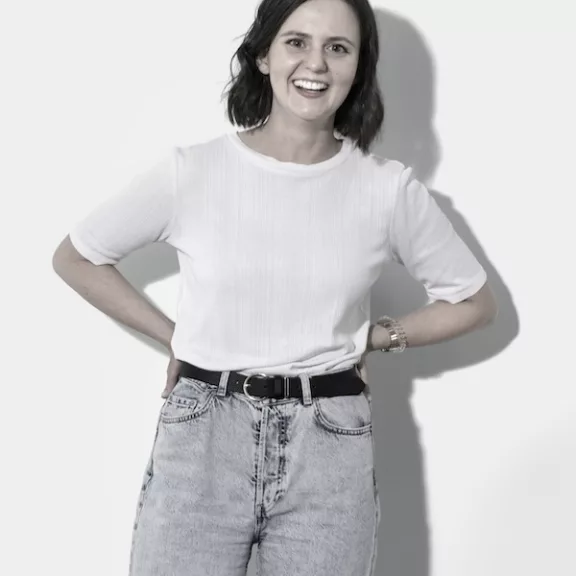
Hello! <– Isn’t that a friendly, inviting introduction to this text? Do you perhaps even feel directly addressed, or, as they like to say in advertising jargon: “picked up”? Yes? How nice! It didn’t take much: Just a few weeks of throbbing headaches, gnawing self-doubt and anxious procrastination. In this article, copywriter Anna reveals why all beginnings are difficult and how the word “lightness” comes off the keyboard with much more ease.
Hello!
I’m Anna and I’m responsible for texts at schalk&friends. Long and short, simple and complex, charming and precise. SOMETIMES THEY ARE LOUDER THAN THE SATURDAY AFTERNOON SIREN WHEN YOU HAVE A NASTY HANGOVER! Sometimes they hit quickly, quietly and unerringly like a ninja’s throwing star.
But before it gets that far, before a text can reveal its essence and unfold its effect, it is usually one thing first: not there. In my day-to-day work, I therefore stare at endless white expanses more often than Amundsen and Scott at the South Pole. The two polar explorers know all about snow blindness – if you’ve never experienced it, you’ll quickly lose your bearings. That’s why it makes sense to have a competent team and good equipment with you. For texting, polar exploring and everything else that is important to you.
Tip 1: The right equipment
Length. Content. Search engine optimisation. Correctness. Comprehensibility. Charm. A text usually has to fulfil many different requirements. That’s why it’s wise to pack your rucksack before you start writing: Brand strategy, SEO keywords, communication goals and the desired tonality should definitely be included. And because nothing works without provisions, you shouldn’t skimp on food either: a large vocabulary, linguistic confidence and comprehensive information on the respective topic are good food for empty pages.
A text without substance is like a dog sled without dogs. But a text without a voice, without character, corners and edges is even worse: it seems interchangeable, irrelevant and is quickly forgotten.Tip 2: The right direction
Orientation is everything. Anyone looking for the South Pole should therefore regularly look at a compass. If you want to find effective words, you should also keep checking your own point of view: Is what you have written relevant? Is it understandable? Does it contribute to the previously defined communication goals?
With the help of special programmes and professional expertise from the SEO team, it is easy to determine whether a text is suitable for search engines – and for the people who are supposed to read it. Whether content works is primarily measured by the conclusion of the pre-defined target group(s). Those who not only consult stakeholders at the end, but also involve them in the writing process at regular intervals, save time, energy – and unnecessary miles travelled.
Tip 3: The right emergency plan
What works when nothing works? Creative processes can be as unpredictable as the weather in Antarctica. The mean thing about snowstorms and writer’s block is that the more you fight against them, the harder it becomes to make progress. It can be helpful to simply take a break, go for a walk, dedicate yourself to another task and clear your head again. If you have to deliver output, you always need input – and inspiration usually comes when you least expect it.
Tip 4: The right goal
If you want to get to the South Pole, every centimetre you miss is one too far north. If you want to produce the best possible text, every word that fails to make an impact is one too many. That’s why it’s important to know when to stop! Has everything important been said? Have all the requirements been met? Are there no questions left unanswered? Then it’s time to make the final point – the sooner the better.