User First, beauty Second: Why user-centricity has top priority in 2025.
Digital change is rapid. Aesthetic design alone is no longer enough to convince users. In 2025, the focus will be on true user-centricity: UX must be functional, inclusive and strategically thought through in order to offer added value. Our top 5 trends show how the user experience of the future can be designed and why it is essential.
1. Accessibility: Innovation through inclusion
From 2025, the German Accessibility Strengthening Act (BFSG) will become binding – a turning point for UX design. Accessible solutions not only promote inclusion. They improve usability for everyone. Adaptive designs such as scalable interfaces or voice control establish new standards and ensure greater customer loyalty, conversions and competitive advantages. A UX that is accessible to everyone is not only ethically correct, but also makes economic sense.
Advantages of an accessible user experience:
- Customer loyalty:
An accessible website retains existing customers. - More conversions:
Fewer cancellations lead to more completed transactions. - Image gain:
Companies show that they are inclusive and progressive. - Competitive advantages:
Differentiating features are created compared to the competition. - Increased productivity:
Accessible design is often also efficient design.
2. Sustainability: Think ecologically, act digitally
Sustainable UX is more than just a trend: it is becoming the standard. Low-resource designs, dark modes and optimised codes not only reduce energy consumption. They also strengthen a brand’s image. Users honour sustainable brands with loyalty and companies benefit from cost savings and a positive ecological footprint.
3. No-interface design: technology that disappears
Interaction without touch, completely without visible interfaces – thanks to smart technologies such as voice assistants or wearables, this is possible. The trick is to make complexity invisible and still guarantee maximum user-friendliness.
4. Understanding business and strategy: UX is thought entrepreneurially
In times of tight budgets, UX will only survive if its value is clearly measurable. UX teams must link their strategies to corporate goals and demonstrate success using KPIs such as conversion rates or customer satisfaction. Only then will UX become indispensable as a strategic discipline – and can secure a competitive advantage in the long term.
5. Artificial intelligence: UX meets high-tech
Link personas with AI:
With AI, personas can be rethought and further developed automatically. By specifically training AI tools with validated personas, targeted content can be developed and the understanding of target groups can be sharpened. If things need to be done quickly and existing personas are very well validated, it is even possible to conduct small interviews with the AI in this way. However, the results should be treated with caution and interviews with real users should always take priority.
AI for UX testing & research:
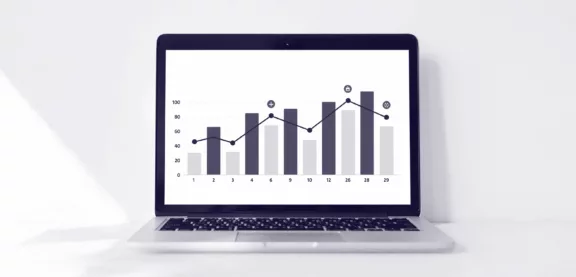
The integration of artificial intelligence into UX testing and research is revolutionising the entire design process. AI tools make it possible to analyse large amounts of data faster and more precisely, allowing designers and researchers to focus more on strategic decisions. New technologies such as machine learning and natural language processing are also creating opportunities to utilise qualitative and quantitative data more efficiently.
Advantages of using AI for UX testing & research:
- Automation of routine tasks:
AI tools take over repetitive tasks such as data sorting, log creation and pattern recognition. This saves time and reduces human error, allowing the focus to be placed on strategic decisions. - Accelerated evaluation of large amounts of data:
AI analyses extensive user interactions or feedback in seconds, which would otherwise take days. This means that findings can be incorporated into the design process more quickly. - Improved sentiment and text analysis:
technologies for language processing identify moods, topics and potential pain points in user comments. This provides deeper insights into the needs and emotions of the target group. - Predicting user behaviour:
Machine learning helps to identify patterns in user data and model future behaviour. This supports the development of proactive solutions before problems occur. - Cost efficiency:
By automating and reducing manual labour, AI tools are more cost-efficient than traditional methods in the long term. Companies can therefore carry out more test cycles without breaking their budgets.
Hyper-personalization through human-centered AI:
In 2025, hyper-personalisation will revolutionise the user experience, with AI systems creating dynamic experiences tailored to individual needs in real time. Thanks to advanced AI technologies, applications and interfaces can respond to users’ preferences, behavioural patterns, contexts and even moods. Human-centred AI (HCAI) ensures that this technology remains ethical, transparent and user-friendly. This means that the design of the user experience is not only efficient, but also focusses on people. The combination of data-based precision and human sensitivity defines the UX of the future.
Conclusion: Set the course for digital excellence now
The year 2025 marks a turning point in user experience: from accessible and inclusive designs to sustainable digital solutions and hyper-personalisation through AI – UX trends are characterised by innovation and user centricity. Technologies such as no-interface design and human-centred AI are setting new standards in terms of interaction and efficiency, while a new understanding of business is making the strategic value of UX tangible. Companies that embrace these trends early on will secure decisive competitive advantages, strengthen their brand and increase the ROI of their digital measures.
Let’s take your UX to a new level together and create digital experiences that impress and have a lasting effect.
More trend articles: