Website maintenance plays a crucial role in any digital strategy. With traditional approaches, small and medium-sized enterprises in particular quickly reach their limits. The demands are high: content must be created quickly, maintained consistently and delivered flawlessly from a technical perspective.
With a structured web design framework within the CMS, based on the Atomic Design approach, a solution is in sight that will enable these complex challenges to be tackled efficiently, flexibly and sustainably.
Content management in practice: different approaches
If you want to manage your content effectively, you need to strike a balance between efficiency and creative freedom – and find the approach that really works for you. There are three key approaches:
Layout-drivencontentmanagementoffers editors maximum creative freedom. Spacing, colours and typography can be customised, just as in a design programme. But this freedom comes at a price: every new layout means extra work and carries a risk of errors. The result: long implementation times and design consistency that is difficult to control.
The alternative to this iswebsite maintenance based onstructured data. Here, editors enter content into clearly defined forms. A template ensures that the content is automatically integrated into the desired layout. The advantage is obvious: a consistently structured and targeted implementation. However, the method is not very flexible and is therefore particularly suitable for clearly defined, recurring content such as product pages or contact forms.
The middle ground between the two extremes: astory builder with modular components. In practice, this offers real added value, as ready-made modules that can be used and combined flexibly provide a high degree of creative freedom. These can be generic building blocks such as ‘text/image’ or specialised website components such as a product or people module. Handy: the modules can be adapted to specific needs without losing structure or consistency.
Atomic design: a systematic approach to success
The Atomic Design approach forms the basis for modern modular design systems. It literally breaks the design down into its smallest components, known as atoms – these include, for example, buttons, fonts or colour codes. These atoms are then assembled into molecules and organisms until a complete layout is created.
Why is this approach so effective? Among other things, because the system adapts flexibly to requirements and because layouts can be optimised independently of the content. A real-world example: at medical technology manufacturer Brainlab, a modular system enabled content management to be carried out up to 80% faster and made ten times more efficient than previously using conventional methods.
What makes the Atomic Design approach unique is that, rather than viewing the layout as a mere form, it is defined in terms of content. Thus, a module is not described as a ‘three-column header’, but rather, for example, as ‘benefit communication’. This semantic understanding ensures that layout and content can be developed separately – an invaluable advantage in dynamic contexts.
Modern CMS trends: live preview for intuitive work
Traditional CMS solutions require switching between the editor and the preview. This is often tedious and time-consuming. The future lies with systems featuring live previews: editors can see in real time how their changes affect the website. This not only saves time but also unlocks creative potential. A look at the Brainlab case study illustrates the benefits: with a live preview system, the team was able to set creative benchmarks because they could design content in an exploratory way whilst directly experiencing the interplay between design and content. This innovation made it possible to tell digital stories in a more intuitive and inspiring way – a game-changer for any modern marketing team.
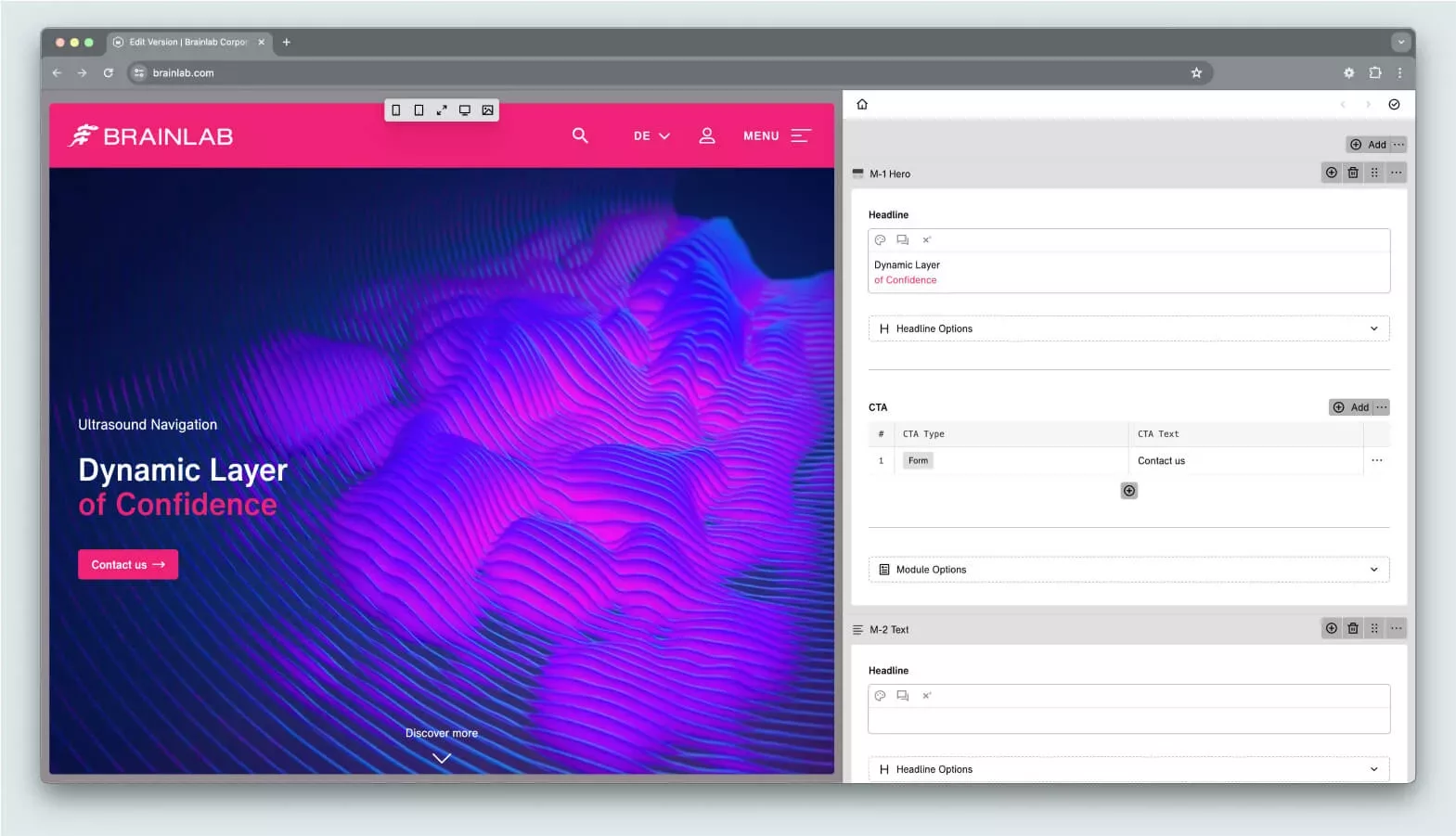
More creativity, more design freedom: a modular website leaves more room for what matters most
A modern CMS that works intuitively and efficiently makes a noticeable difference to day-to-day work. Team members can focus on their core tasks – such as storytelling or devising creative campaigns. The system helps the team complete repetitive tasks more quickly and without errors, leaving more time for creative processes or driving innovation. For example, recurring content structures can be grouped into specific templates and easily reused across the website. All of this leads to greater satisfaction and enjoyment when working in the CMS. And ultimately, it also leads to increased self-efficacy. That’s motivating.
Such a system also offers benefits for marketing managers: it helps them to better manage constant time pressures, make the most of limited resources and, at the same time, motivate the team. A CMS that inspires and motivates can have a positive impact on the entire department – and lay the foundations for achieving ambitious goals. Ideally, this creates valuable synergy between operational implementation and strategic leadership.
A website builder that your team will love
At schalk&friends, we understand the challenges faced by marketing departments in medium-sized companies. Drawing on our expertise, we develop bespoke modular systems that are flexible and compliant with your corporate identity. Our approach: partnerships on equal terms, where the focus is not solely on technical solutions. As a strategic sparring partner, we develop individual, sustainable and long-term solutions.
Turn your CMS into a tool that takes the pressure off your team and inspires them. We’d be happy to offer you a no-obligation consultation and show you possible solutions and practical approaches for your practice.

Atomic Design: efficient content management with modular CMS systems